
Robert Light, CEO of CarrierSource, posted something on LinkedIn recently that stopped me in my tracks. He shared a real ChatGPT screenshot where a shipper searched "best reefer carriers in Dallas," and the AI returned a ranked list of carriers pulled from CarrierSource reviews, complete with ratings and fleet details.
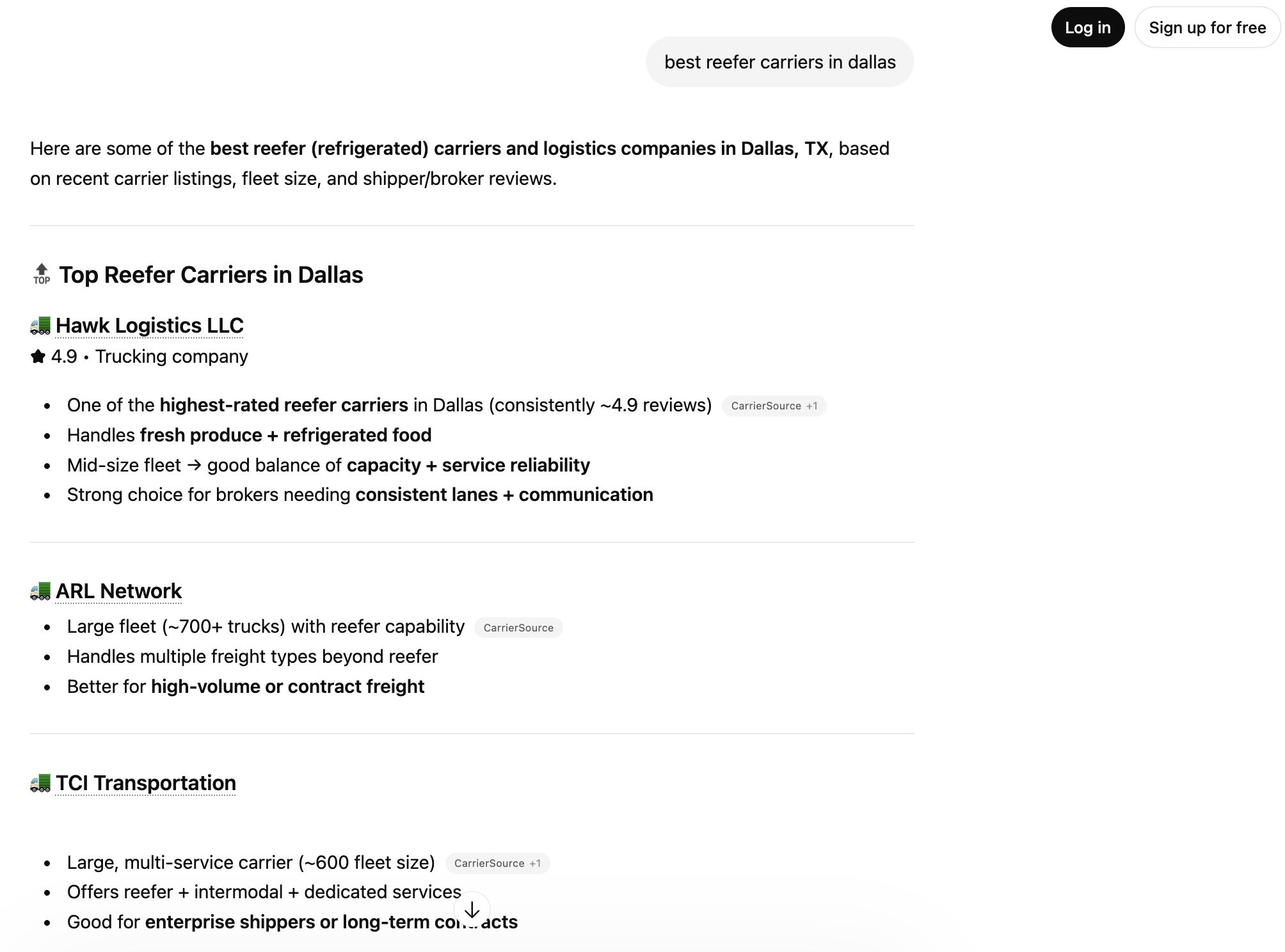
His line was simple and it hit hard: "If your company doesn't show up in that answer, you don't exist."
That's not hyperbole. That's happening RIGHT NOW in freight. And it made me want to put a longer piece together around the data we're seeing, the patterns across our client work, and why most logistics companies are completely invisible to the buyers who need them most.
Not because they're bad at what they do. Because they've been sold a version of marketing that was never designed to get them there.
The Tactics Trap That's Costing Logistics Companies Real Pipeline
Here's what happens at most logistics companies when someone says "we need to do marketing." A blog gets launched. A trade show booth gets ordered. Somebody starts posting on LinkedIn twice a week. Maybe Google Ads gets turned on.
Six months later, the CEO asks, "What did we get from all that?" And nobody has a good answer. So marketing gets cut, or it limps along as a line item nobody believes in.
This pattern is so common in logistics, transportation, and supply chain that it's practically an industry tradition. And the reason it keeps happening is because what most companies call "marketing" isn't actually marketing. It's a collection of tactics bought off a shelf with no strategy underneath.
Mats Georgson, whose research on demand dynamics has influenced how some of the sharpest growth companies in the world think about markets, puts it this way: demand precedes products. Situations come before solutions. If you're not present in the situation where a buyer's need becomes actionable, the best website in the world won't save you.
That's a fundamentally different starting point than "let's write some blogs about LTL shipping."
What the Data Says About How B2B Logistics Buyers Actually Find Vendors Now
The buying landscape shifted underneath this industry while most companies were still arguing about whether they needed a marketing person at all.
Consider what's actually happening:
Half of B2B buyers now start their purchasing journey in an AI chatbot instead of Google
Source: G2, 2025
Not alongside Google. Instead of it. And Gartner projects that by 2028, 90% of B2B purchasing will be intermediated by AI agents.
Meanwhile, 58.5% of Google searches already end without a click to any website. The buyer got their answer from an AI Overview, a featured snippet, or they went to ChatGPT instead.
Traffic from AI sources converts at 14.2%, compared to 2.8% from traditional organic search
Source: Conductor AEO/GEO Benchmarks Report, 2026
That's not a marginal improvement. That's a 5x conversion multiplier for companies that show up in AI-generated answers.
Here's what this means for logistics companies specifically: your buyer is asking an AI, "Who are the best cold chain logistics providers for pharmaceutical distribution?" or "Which freight brokerages specialize in hazmat loads?" and the AI is generating a shortlist. Robert Light's CarrierSource screenshot is the proof. A shipper typed "best reefer carriers in Dallas" into ChatGPT and got back a ranked list with ratings, fleet sizes, and service descriptions. The carriers who had invested in reviews and visibility showed up. Everyone else was invisible. If your company isn't in the training data with credibility signals, with depth, with real expertise demonstrated publicly, you're not on that list. You don't exist in that moment.
And that moment is when the buying decision gets shaped.
Why Your Marketing Budget Keeps Producing a Sugar High
We work exclusively with logistics, supply chain, and transportation companies. Have for years. And the pattern we see over and over is companies spending real money on marketing activities that produce a temporary spike and then nothing.
A Google Ads campaign that generates clicks but no qualified pipeline. A content calendar full of generic "What Is LTL?" articles that rank for nothing and teach nobody anything they couldn't find in ten seconds. A social media presence that's essentially a digital press release feed.
Les Binet and Peter Field's research on marketing effectiveness calls this the "short and long of it" problem. Short-term activation tactics, things like paid ads and promotions, create spikes. But those spikes decay fast. Long-term brand building is what creates sustained, compounding growth. Their data shows the optimal split is roughly 60% brand, 40% activation (eMarketer).
In logistics? Most companies are running 95% activation and 0% brand. And then wondering why nothing compounds.
One supply chain technology company we partnered with had been running Google Ads for over a year before we started working together. Spending real money. When we audited their positioning, we found they were competing on the same five keywords as every other company in their category, with no differentiation in messaging, no content depth, and no brand presence that would make a buyer remember them over anyone else.
Within twelve months of building an actual marketing system, that same company generated 539 inbound leads. Sixteen of those became customers, each averaging $200K in annual gross revenue. That's $3.2 million in new revenue from a marketing program that started with MESSAGING, not media spend.
The difference wasn't more tactics. It was building the foundation that makes tactics actually work.
The Foundation Most Logistics Companies Skip
Phil Pilalas, whose work on problem-first marketing has shaped how we think about content strategy, says something that should make every logistics CEO uncomfortable: nobody searches for a solution to a problem they don't think they have.
If your marketing leads with your solution, your technology platform, your network map, your trailer count, you're only talking to the 3-5% of buyers who are actively in-market right now. The other 95-97% don't know they have a problem yet. Or they know but they're not ready to act.
REAL marketing for logistics companies starts before the buyer is ready. It starts with the SITUATION.
When we onboard a new logistics client, we don't start with keywords or content calendars. We start with three questions that come directly from demand dynamics research:
In which recurring situations is your company reliably remembered today? That defines your current market.
In which adjacent situations could your company be meaningfully recalled? That defines your growth perimeter.
Where are you operationally strong but cognitively absent? That reveals wasted capability.
A specialized carrier we work with came to us calling themselves a freight broker. When we mapped their demand points, we discovered their buyers weren't searching for "freight broker" at all. They were searching for solutions to a very specific operational problem: readiness. The entire positioning shifted. New language. New content architecture. New search behavior targeted. Same company, same capabilities, completely different presence in the market.
That's not a tactic. That's MARKETING.
What AI Discovery Means for Logistics Companies Right Now
The conversation about SEO in logistics needs to evolve, and fast.
Traditional SEO still matters. Organic search still delivers the highest long-term ROI of any marketing channel, 748% according to 2026 benchmarks (Martal Group), compared to 36% for PPC. But the game has expanded.
Answer Engine Optimization, what some call AEO or GEO (Generative Engine Optimization), is the practice of structuring your content and brand signals so that AI platforms like ChatGPT, Perplexity, Gemini, and Google's AI Overviews can cite your company as an authoritative source.
Steve Patti, a CMO who has built brands across multiple industries over four decades, calls this survival-level marketing. "Customers are asking ChatGPT for recommendations before they ever open Google. If you're not optimized for AI discovery, you're already behind."
What does AI discovery optimization actually look like for a logistics company?
It means having DEPTH. Not twenty surface-level blog posts about supply chain management. Ten deeply authoritative pieces that answer specific operational questions with real expertise. AI systems reward definitions, comparisons, step-by-step operational detail, and clear structure. They do not reward vague thought leadership or product-first content.
It means having CONSISTENCY. LinkedIn is the second most-cited domain by large language models (Semrush, 2025). Your leadership team's presence on LinkedIn isn't vanity. It's a credibility signal that feeds directly into how AI systems evaluate your brand's authority.
It means having STRUCTURE. Schema markup, entity clarity, well-organized content hierarchies. AI crawlers parse structured information. They skip over vague product descriptions and unstructured blog posts.
And critically, it means having a POINT OF VIEW. AI surfaces brands that take clear positions on industry problems. The commodity logistics companies, the ones saying "fast, reliable, global network" the same as everyone else, get filtered out. The companies that own a specific perspective on a specific problem get cited.
We built the Logistics AI Search Visibility Index to help logistics companies see exactly where they stand in this new landscape. Because you can't fix what you can't measure, and most logistics companies have no idea whether they're visible in AI-generated answers or completely absent.
Building the System, Not Buying the Tactic
Chris Walker, who built Refine Labs into one of the most influential B2B marketing voices of the last decade, draws a sharp line between creating demand and capturing demand. Most logistics companies spend 100% of their budget trying to capture the tiny slice of buyers who are actively searching right now. Almost none invest in creating demand, in building the brand presence and thought leadership that puts them on the shortlist BEFORE the buyer ever starts searching.
When that VP of Supply Chain types their question into ChatGPT, the answer is already shaped by everything your company has (or hasn't) published, shared, demonstrated, and stood for in public. The race is over before the starting gun fires.
The logistics companies that will own the next decade of growth are the ones building marketing as a SYSTEM. Not a collection of disconnected tactics, but an integrated infrastructure that does four things simultaneously:
Identifies where demand actually lives. Not assumed demand based on what you sell. Real demand, mapped to the situations where buyers' needs become actionable.
Creates recall at the right moments. When the buyer's situation fires, when the pain becomes acute enough to act, your brand is the one that surfaces. In their memory. In Google. In ChatGPT. In the recommendation from a peer.
Achieves outcome dominance. Once your brand reliably resolves the buyer's situation, evaluation collapses. You become the reference point. Competitors don't just lose the comparison. They vanish from consideration.
Compounds over time. Every article, every LinkedIn post, every case study, every piece of content that connects your brand to a demand point does double duty. It strengthens your recall AND it weakens competitor recall. Cognitive science calls this retrieval-induced forgetting. It's not metaphorical. When one memory trace gets strengthened, competing traces are actively suppressed.
That's not a six-month project. That's a marketing operating system. And it's the only thing that produces durable growth in a commoditized industry.
The Uncomfortable Math
Here's the number that should keep every logistics CEO up at night: over any three-year period, only 6-10% of brands meaningfully grow market share (Kantar brand equity data, also cited in Georgson, Demand Point Constellations). The rest stay flat or decline. And many of the brands that stagnate aren't doing nothing. They're advertising, innovating, expanding distribution, attending every trade show, running every playbook.
They're just fighting over demand that's already been claimed.
The logistics companies that grow, really grow, are the ones that find NEW demand points. New situations where their brand can be the answer. New categories where they can be first. New problems they can own before anyone else even names them.
Content marketing costs 62% less and produces three times more leads than traditional outbound. SEO compounds year over year while paid advertising resets to zero the moment you stop spending. And AI discovery is creating an entirely new channel where the most credible, most structured, most deeply authoritative brands get surfaced to buyers who never would have found them through a trade show or a cold call.
The question isn't whether your logistics company can afford to invest in real marketing. The question is whether you can afford not to.
The Robinson Agency works exclusively with logistics, supply chain, and transportation companies as their embedded marketing department. We don't sell tactics. We build marketing systems that make your brand the answer when your buyers' situations become actionable. Learn more about how we work.
ABOUT THE AUTHOR
Adam Robinson is the Founder and CEO of The Robinson Agency, a full-service marketing firm that operates exclusively within the logistics, supply chain, and transportation industry. With deep expertise in demand dynamics, brand strategy, and AI search visibility, Adam partners with logistics companies as their fractional marketing department, building the infrastructure that turns brand presence into pipeline.